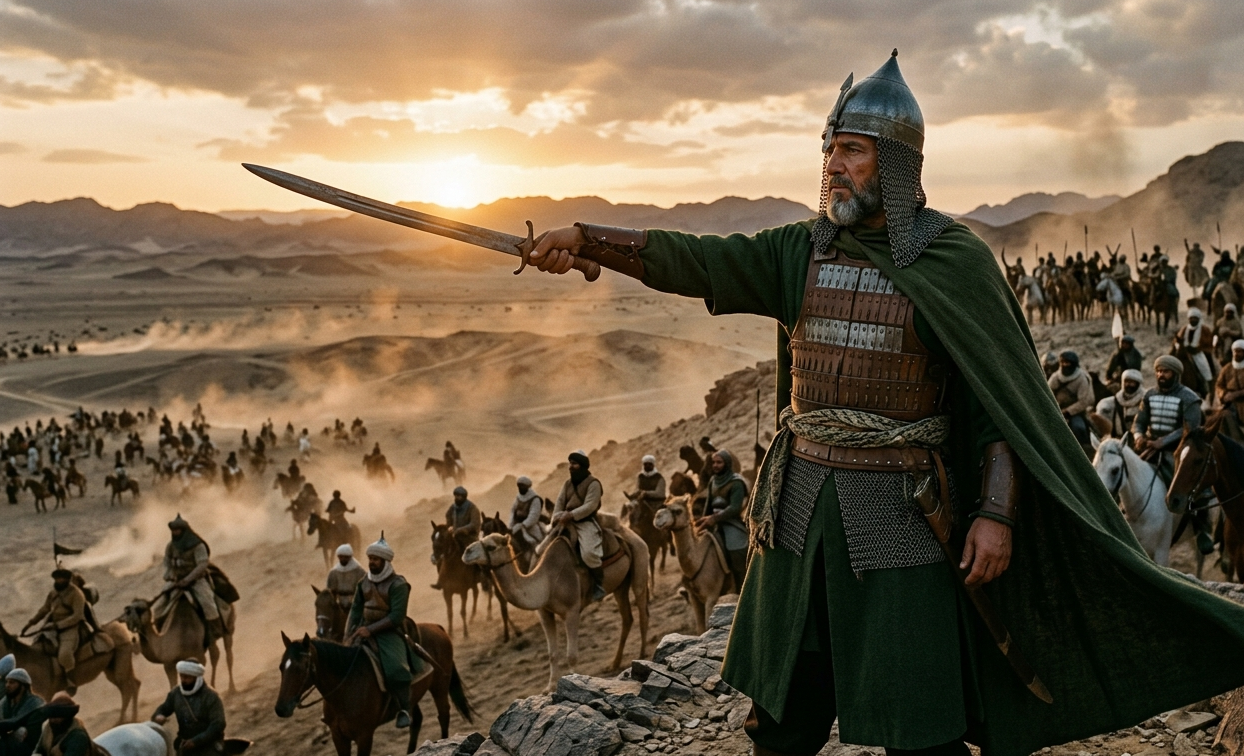
A Name That Made Empires Tremble
There are names in history that carry the weight of entire eras — names that, when spoken, conjure images of dust-choked battlefields, unfurling banners, and the resolute hearts of men who believed they were fighting for something greater than themselves. Khalid bin Waleed (R.A.) is one such name. He was not merely a general. He was a phenomenon — a military mind so extraordinary that even his enemies could not help but marvel at his genius.
Born into the noble Banu Makhzum clan of the Quraysh tribe in Mecca, Khalid grew up in the heart of Arabian aristocracy. i give you all information about Khalid bin Walid: The Sword of Allah — A Warrior Whose Flame History Could Never Extinguish. His family was known for producing warriors, and from childhood, Khalid absorbed the art of combat the way most children absorb language—naturally, instinctively, and with startling fluency. He was not trained to be great. Greatness simply ran through him like a current.
But what makes his story uniquely compelling is not just his brilliance on the battlefield. It is the profound transformation of a man who once fought against Islam and later became its most devastating defender. Few arcs in human history are this dramatic, this complete, or this sincere.
Before the Light: A Formidable Enemy
Before his conversion, Khalid bin Waleed was a thorn in the side of the early Muslim community. At the Battle of Uhud in 625 CE, it was Khalid who spotted the fatal error of the Muslim archers abandoning their hilltop position. His cavalry charge was swift, precise, and merciless—turning what had been a Muslim victory into a devastating reversal. The Quraysh celebrated. Khalid was their champion.
For years, he fought with everything he had against the growing tide of Islam. And yet, something quietly stirred within him. He watched the companions of the Prophet Muhammad (PBUH)—how they carried themselves with dignity, with conviction, and with a peace that no amount of worldly triumph had ever given him. He had gold, status, and military glory. But there was a hollow space inside him that none of it could fill.
The Moment That Changed Everything
Around 628 CE, Khalid’s brother Waleed bin Waleed—who had already embraced Islam—wrote him a letter. In it, he mentioned something that stopped Khalid cold: the Prophet Muhammad (PBUH) himself had reportedly asked why a man of Khalid’s intelligence had not yet found the truth.
That single piece of information struck him like a thunderbolt. The Prophet (PBUH) was thinking about him. Not as an enemy to be defeated, but as a soul worth reaching.
In 629 CE, Khalid traveled to Madinah and accepted Islam in the presence of the Prophet (PBUH). The reception was warm beyond anything he expected. And then came the title—spoken by the Prophet (PBUH) himself—that would define Khalid for all of history: Saifullah. The Sword of Allah.
From that moment, the most dangerous enemy Islam had ever faced on the battlefield became its most powerful protector.
Table of Contents
A General Without Defeat
What followed was one of the most extraordinary military careers in recorded human history. From 629 CE until his death in 642 CE, Khalid bin Walid fought in over 100 battles—and he never lost a single one.
Not one defeat. Ever.
At the Battle of Mu’tah (629 CE), three Muslim commanders fell in rapid succession against a massive Byzantine force. When Khalid took command — without any formal appointment, simply because the moment demanded someone capable — he reorganized the battered Muslim forces, executed a brilliant tactical withdrawal, and brought the army home intact. The Prophet (PBUH), receiving news of the battle while still in Madinah, named Khalid as the one Allah had chosen to lead before any messenger had arrived with the report.
During the Ridda Wars (632–633 CE), when Arabia shattered after the Prophet’s (PBUH) death and false prophets rose to tear the young Muslim state apart, it was Khalid whom Caliph Abu Bakr (R.A.) unleashed across the peninsula. He moved with extraordinary speed, striking rebellions before they could consolidate, never giving chaos time to breathe.
His conquest of Iraq (633–634 CE) saw him dismantle the Persian military machine battle by battle, city by city, against one of the ancient world’s most seasoned fighting forces. Then, in a move still discussed with awe by military historians, he conducted a legendary forced march across the Syrian desert — a route considered impassable — to strike Byzantine forces from a direction they never anticipated.
The Battle of Yarmouk (636 CE) stands as the masterpiece of his career. Against a Byzantine army that vastly outnumbered the Muslim forces, Khalid orchestrated a battle plan of breathtaking complexity—feigning retreats, using his cavalry to encircle enemy formations, and maintaining coordination across a massive front without any modern communication. The Byzantine Empire lost its grip over the Levant in a single engagement. Khalid had not just won a battle. He had redrawn the map of the world.
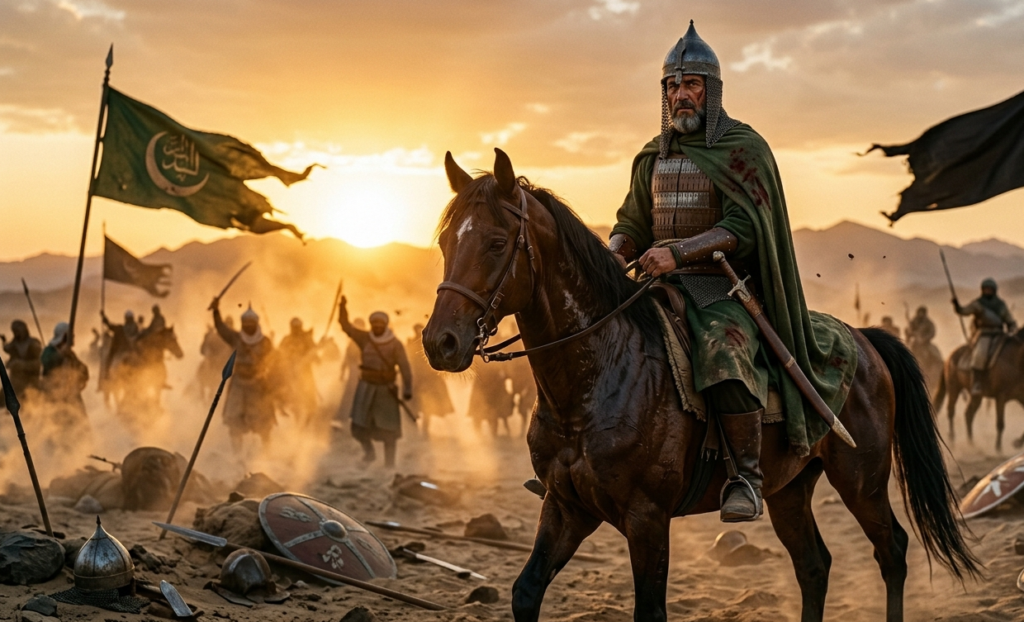
The Man Behind the Legend
History tends to flatten its greatest figures into monuments. But Khalid bin Waleed was deeply, powerfully human.
He was spiritual in ways that surprised people who only knew his reputation as a warrior. He wept in prayer. He felt the burden of every life lost under his command. When Caliph Umar ibn al-Khattab (R.A.) removed him from military command—a decision that stunned the Muslim world—Khalid accepted it without bitterness or rebellion. He continued to serve as an ordinary soldier under commanders he had once led. That is not the behavior of ego. That is the behavior of genuine faith.
He was also blunt to the point of discomfort, impatient with politics and formality, and possessed of enormous self-confidence that was, in fairness, consistently proven right. He had no patience for hesitation when decisiveness was needed. But beneath that iron exterior was a man who understood loyalty—not as a transaction, but as a commitment that did not expire when circumstances changed.
The Final Years and a Warrior’s Honest Grief
Khalid bin Walid died in 642 CE in Homs, Syria—not on a battlefield, but quietly, in a bed.
This, by his own account, was his deepest sorrow.
As death approached, he was reported to have looked at his body—scarred from a hundred battles, marked by sword cuts and arrow wounds from head to foot—and said that he had fought in so many engagements, and yet here he was, dying like an old camel in his home. He had longed his entire life to die as a martyr. That wish was not granted.
There is something profoundly moving about this final honesty. The Sword of Allah— undefeated general, conqueror of Persia and Byzantium, the man who reshaped civilizations—faced his own death with no performance, no pretense. He simply felt what he felt. He said what was true.
Conclusion: What Khalid bin Waleed Teaches Us Today
Khalid bin Waleed’s life is not just a chapter in an Islamic history book. It is a living lesson for every generation that reads it.
He teaches us that greatness is not about where you start—it is about what you choose. He began as Islam’s fiercest opponent and became its greatest military protector. That kind of transformation does not happen by accident. It happens when a person has the courage to question themselves honestly, follow the truth wherever it leads, and then commit to it completely.
He teaches us that talent alone is never enough. Khalid was gifted beyond measure, but his gifts meant nothing until they were anchored to a purpose greater than personal glory. The moment he placed his sword in the service of his faith, he became not just a great warrior but a great man.
And perhaps most powerfully, he teaches us humility in power. When the Caliph removed him from command, Khalid did not rage or revolt. He picked up his shield as an ordinary soldier and kept fighting. That is a lesson in ego-death that most powerful people never learn.
Over 1,400 years later, the name Khalid bin Waleed still echoes. That is not coincidence. That is legacy—earned one battle, one sacrifice, and one honest moment at a time.
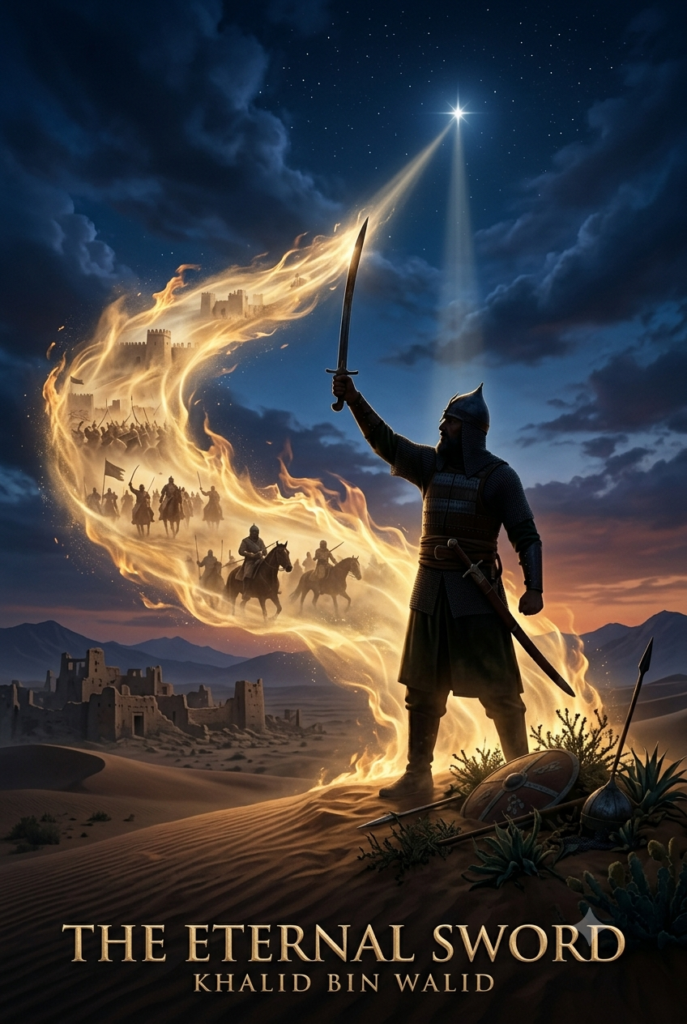
Frequently Asked Questions (FAQs)
Q1: Who was Khalid bin Walid, and why is he so famous? Khalid bin Waleed (R.A.) was a 7th-century Arab military commander who served under Prophet Muhammad (PBUH) and the first two caliphs—Abu Bakr and Umar (R.A.). He is famous for being undefeated in over 100 battles, earning the title Saifullah (Sword of Allah) from the Prophet (PBUH) himself. His campaigns against the Persian and Byzantine Empires dramatically expanded the early Islamic state.
Q2: Did Khalid bin Waleed ever lose a battle? According to classical Islamic historical sources, Khalid bin Walid never lost a single battle throughout his entire military career—spanning from before his conversion to Islam all the way to the great conquests of Iraq and Syria. Military historians consider this record virtually unparalleled in ancient warfare.
Q3: Why did Khalid bin Waleed convert to Islam? Khalid’s conversion was a deeply personal spiritual journey. He reportedly felt an inner emptiness despite his worldly success and observed the profound peace and character of the Prophet’s (PBUH) companions. The turning point came when he learned that the Prophet (PBUH) himself had wondered about Khalid, seeing in him a man whose intelligence and strength could serve the truth. Khalid traveled to Madinah in 629 CE and accepted Islam.
Q4: What does “Saifullah” mean, and who gave Khalid this title? “Saifullah” is an Arabic title meaning “The Sword of Allah.” It was given directly to Khalid bin Waleed by Prophet Muhammad (PBUH) after Khalid’s extraordinary performance at the Battle of Mu’tah in 629 CE, where he took command of a losing battle and successfully withdrew the Muslim forces without catastrophic losses. It is one of the most distinguished titles ever given to any companion.
Q5: Why did Umar (R.A.) remove Khalid bin Waleed from command? Caliph Umar ibn al-Khattab (R.A.) removed Khalid from military command during the Syrian campaigns around 638 CE. The primary reason scholars cite is that Umar feared people were becoming too attached to Khalid personally—attributing victories to Khalid rather than to Allah’s will and the collective strength of the Muslim army. It was a decision rooted in theological concern, not a reflection of Khalid’s performance or loyalty.
Q6: How did Khalid bin Waleed die? Khalid bin Waleed passed away in 642 CE in Homs (in modern-day Syria) due to natural illness. He died in his bed — a fact that deeply saddened him personally, as he had always wished to die as a martyr on the battlefield. His body bore wounds from dozens of battles, yet death came to him quietly. He was around 58 years old at the time of his passing.
Q7: Where is Khalid bin Waleed buried? Khalid bin Waleed is buried in Homs, Syria. The Khalid ibn al-Walid Mosque was built over his tomb and remains a historic landmark visited by people from around the world to this day.
Q8: What can modern people learn from Khalid bin Waleed? Khalid’s life offers several timeless lessons: the courage to change one’s beliefs when truth demands it, the importance of placing talent in service of a higher purpose, the discipline to accept authority even when you disagree, and the commitment to give your best effort regardless of your rank or recognition. His story reminds us that true greatness is built not on pride but on purpose.

Вывоз грунта является важной частью строительных работ .
Многие компании предлагают услуги по вывозу грунта различными способами .
Перед тем как приступить к вывозу грунта, важно оценить его количество и характеристики .
—
Выбор техники зависит от объема и типа грунта .
В большинстве случаев применяют экскаваторы, грузовой транспорт и другие механизмы.
Важно соблюдать все экологические нормы и правила при работе с вывозом грунта .
—
Планирование и подготовительные работы — ключ к успешному вывозу грунта .
Необходимо заранее определить оптимальные маршруты и график работ .
Также важно иметь договоренности с подрядчиками и поставщиками услуг .
—
Современные технологии значительно упрощают процесс вывоза грунта .
Включение в работу автоматизированных систем и GPS-мониторинг помогает контролировать процесс .
Инвестиции в новые технологии оправдывают себя за счет повышения эффективности и снижения затрат .
вывоз грунта vivozgrunta24 [url=http://vivozgrunta24 ru/]https://vivozgrunta24 ru/[/url]
На представленном веб-сайте есть возможность отыскать обилие практичной сведений.
На страницах сайта размещены статьи и рекомендации для любого интерес.
Читатель сможете найти как общую информацию, так и детальные материалы.
Наш портал способен помочь экспертам в своей практике.
https://ipcfms.ru/read/123-pravila-ukhoda-za-roskoshnymi-krossovkami-dolceandgabbana-iz-kozhi-i-barkhata.html
Помимо этого на сайте часто выкладываются актуальные руководства.
Предлагаем внимательно просмотреть собранную здесь базу.
Следовательно, наш портал является ценным местом сведений.
На данном портале можно найти обилие полезной информации.
https://labdiz.ru/full/543-aksessuary-kak-klyuchevoy-element-obraza-sumki-shlyapy-obuv.htm
Здесь сайте вы сможете отыскать массу нужной сведений.
https://relax-spb.ru/read-info/3255-hailey-jean-novaya-kapsulnaya-kollektsiya-denima-ot-kheyli-biber-i-gap.html
Здесь портале можно отыскать массу полезной материалов.
https://online-festival.ru/detail/3439-sarafannoe-radio-30-letnikh-platev-na-bretelkakh-kotorye-nuzhno-uspet-nadet-do-poslednego-tyoplogo-dnya.html
Web-based experiences present gamers a fantastic avenue to unite and discover with fellow players globally.
https://homirussia.ru/cozy/930-comparative-review-superbet-casino-vs-leading-competitors-in-the-online-slot-market.html
На этом сайте вы сможете найти много полезной информации.
https://sites.google.com/view/sumki-jimmy-choo/main